Work with Counterpedia programmatically
Product promise
Take an identified Counterpedia record into another application or AI agent without losing the version, original sources, or limits attached to it.
Start with a familiar subject
Imagine reading the Boeing 737 MAX entry in a browser, then asking a research agent to work with the same record. The useful result is not simply that both clients return text about Boeing. They should identify the same object and edition, distinguish its supporting documents from the entry’s own account, and tell you which information is available to the requesting client.
This is an example of reading Counterpedia. Running a new Check, changing an entry, publishing research, and accessing someone else’s saved result require their own permissions and operations.
1. Choose the documented read interface
Start with Counterpedia’s maintained developer documentation or machine-readable discovery resources. Choose a supported read interface appropriate for your client: direct API, an SDK, or an MCP-compatible agent. Read the maintained operation description to learn what inputs it expects and what it returns. Do not assume those interfaces have identical tools or permissions.
A request may start with a known object identifier. Its display title alone is not a stable identifier, particularly where similarly named products, proceedings, or people appear together.
2. Read one object and its source context
Use the documented read operation for an identified Boeing 737 MAX record, if the available collection includes one. Otherwise use another real returned record and keep its original identity rather than inventing a Boeing result. Inspect its object identity, type, available version information, cited sources, and access or completeness limits. If a source reference is exposed, use the separate documented read path to inspect it. Do not synthesize a URL or treat a topical resemblance as an identity join.
Expected result: the client can point to one identified object and explain at least one linked reference, rather than producing an unattributed answer about an aircraft.
3. Compare human and machine views
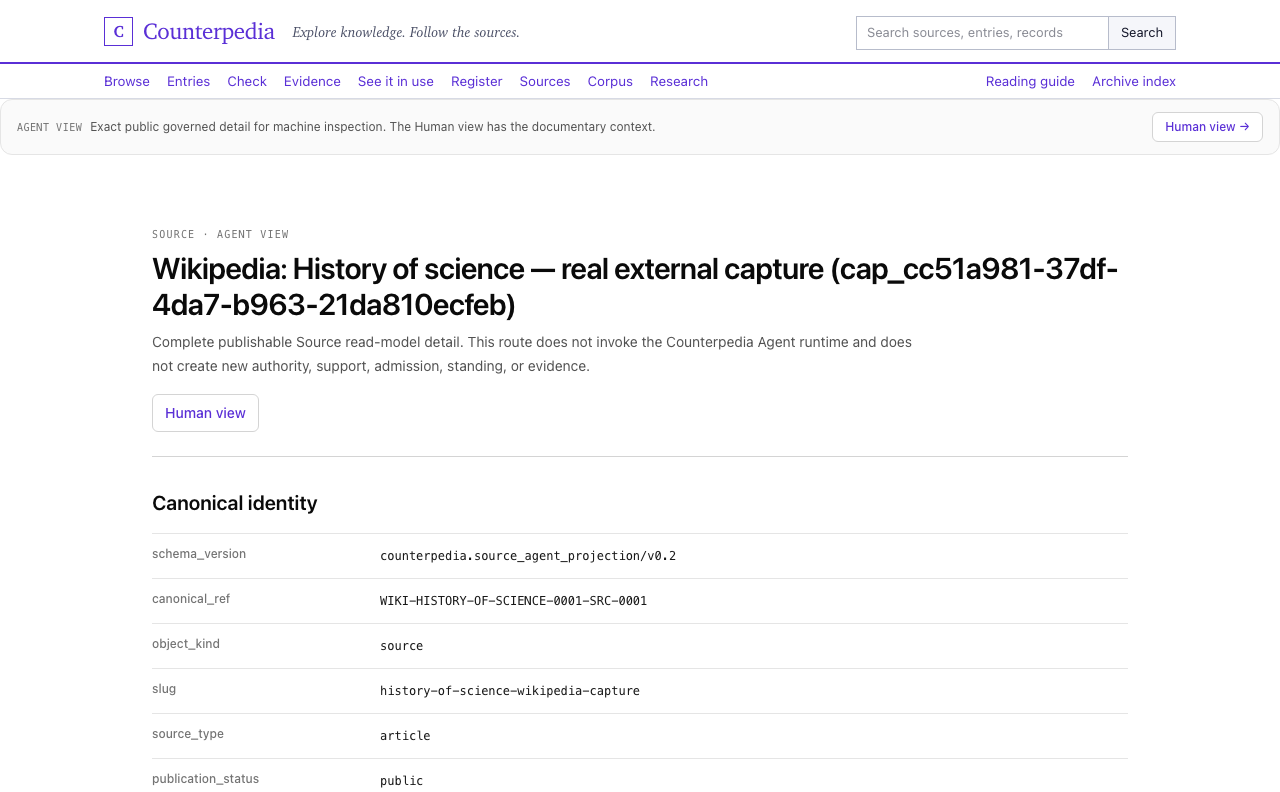
Open the same identified version in Counterpedia’s human reader. Ask whether the subject identity, scope, source references, and recorded uncertainties agree. The machine result may be structured differently, but it should not silently promote an allegation into a finding or omit a limitation material to the answer.
If the client receives no object, a restricted result, or a schema error, preserve that outcome. Do not substitute a different record just to make the example succeed.
4. Reuse without changing authority
Carry the record identifier, edition, source attribution, and permitted inspection destination into the application’s output. Check the document’s licence before copying retained material. A readable receipt is not a new verification, and a machine-readable response does not authorize Check or publication.
For an end-to-end setup and recovery path, continue with Using Counterpedia with agents and software. The complete result is a source-aware read in another client, not an assumption that every integration already exists.
Related manual chapters
- Using Counterpedia with agents and software — the complete integration tutorial.
- Saving, citing, sharing, and exporting — preserve identity and attribution in reused material.