Saving, citing, sharing, and exporting
What this chapter does
You may want to come back to your research, show it to someone else, or use it in a document. Those are different tasks. Saving privately does not make a result public. Copying a link does not make a document permanently available. Downloading an artifact does not grant rights to republish it.
This chapter keeps four operations separate: save, cite, share, and export.
Reader outcome
Preserve an eligible result under your account, return to it later, make a version-specific citation, share a public destination, and distinguish a permitted export from a private record.
Before you begin
Use a real completed Check result eligible for saving, with its source context and the identity authorized to own it. For the citation example, consider the NTSB’s East Palestine derailment investigation: a preliminary report and a later final report have different dates and purposes. A citation must identify the particular document used. Use the original NTSB publication to confirm the report’s exact title, date, destination and permitted reuse before citing or exporting it.
1. Choose what you want to preserve
| Goal | Action | What the recipient receives |
|---|---|---|
| Resume private work | Save a permitted result | A result retrievable under the authorized identity |
| Credit a document | Cite | A publisher, title, edition/date and destination |
| Let others inspect public material | Share | A public destination with its own access conditions |
| Work with exact material elsewhere | Export or download | A permitted file or representation and its identity |
Expected result: you can name the operation you need before clicking anything. A bookmark to a live page, a fixed-version citation, and a private saved result are not interchangeable.
2. Save an eligible result under the owning account
From a completed Check result, inspect whether saving is offered and what information must be retained. Save it using the authorized identity and read the confirmation. Keep the opaque reference or retrieval material according to the operation’s instructions; do not publish private keys in a screenshot or citation.
If saving is refused or unavailable, read the reason. Do not treat that as proof that the underlying statement was false.
3. Reopen it in a later session
Return as the same authorized owner. Use the documented retrieval path and compare the reopened result’s identity, original statement, source version and recorded questions with what you saved. A later source change or another Check should have its own identity, not silently overwrite what was previously assessed.
Expected result: you can tell whether this is the same saved result or new work. If it cannot be found, distinguish missing retrieval material, wrong account, permission refusal and retention limits.
4. Cite the public source and its version
For an East Palestine investigation document, keep the issuing organization, exact title, publication or issue date, specific report or edition, source URL or identifier, and the passage used. The preliminary report is not the final report simply because both concern the same event.
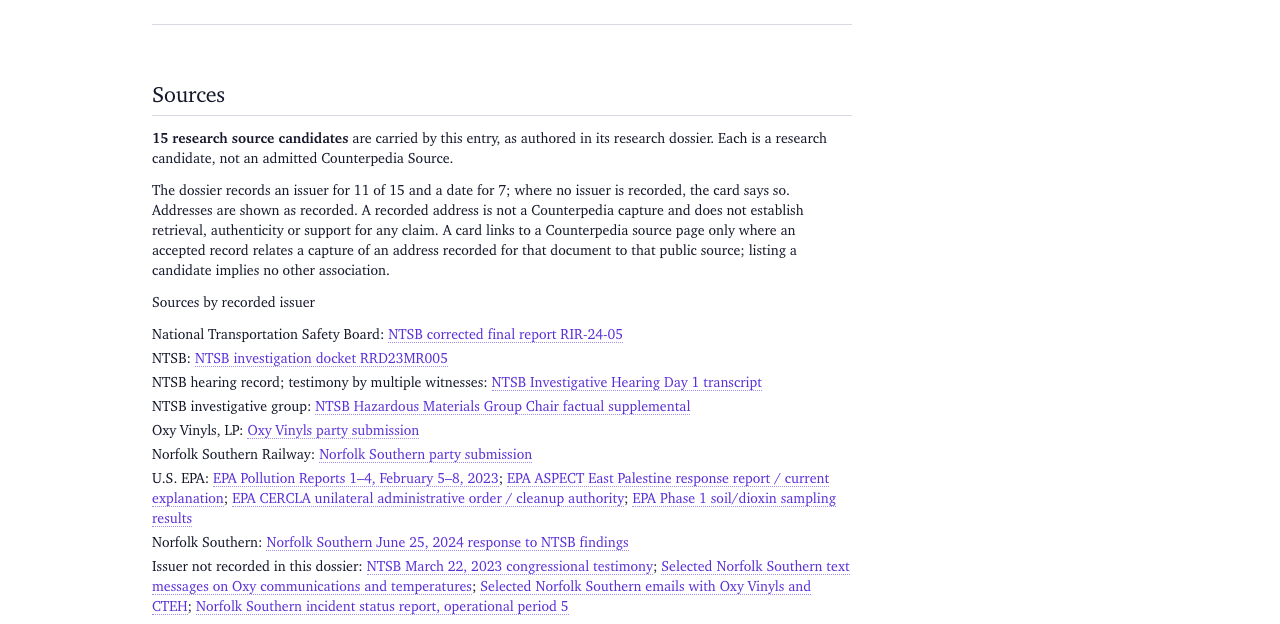
For a Counterpedia entry, also keep the entry identity and the edition or release actually read. A general site link may resolve to updated content and should not be described as a fixed version.
5. Share a destination without sharing private access
Open the public source or eligible public result destination in a second browser session and examine what an ordinary recipient can actually inspect. If the destination points to a restricted result, copying the URL does not change that restriction. Do not send a private receipt, access token or saved-result key merely to demonstrate sharing.
6. Verify a public receipt separately
A published receipt may let a recipient inspect recorded scope and outcomes. When its format supports independent identity comparison, use the documented exact representation and the separately obtained expected identifier or digest. Compute the specified identity and compare it with the expected value.
A match concerns those bytes or that representation under the stated comparison. It is not a rerun of Check, proof of a publisher’s truthfulness, or independent proof of when a document first existed. A mismatch and an unreadable input are different failures; report which one occurred.
7. Export only what is permitted
When an artifact or machine-readable representation is offered, read its available format, version, licence and attribution. Download the permitted material and retain the file identity, not merely the filename. If no export is offered, keep the citation instead of inventing a button or copying restricted source bytes.
8. Recover from a missing or ineligible item
For a failed private retrieval, confirm the owner and required key without exposing it. For a changed public destination, look for an archived or fixed edition and cite the one you used. For unavailable exports, consult the published rights and alternative authorized destinations.
Finish by noting separately what you saved, what you cited, what another reader can open, and what file, if any, you exported. Continue with Check, Record history, or Agents and software.
Corresponding overview
Work with Counterpedia programmatically