Exploring cases and investigations
What this chapter does
Cases bring different people, documents and decisions into one question. This chapter shows how to read that collection without treating an allegation, a sworn declaration, an investigative report and a court order as though they mean the same thing.
Reader outcome
Build a small, attributable chronology and distinguish the participants’ positions from the recorded decisions and the questions that remain open.
Our example: the FTX bankruptcy and recovery record
The collapse of FTX produced bankruptcy court filings, federal enforcement actions, debtor investigations and later recovery announcements. Start with the FTX bankruptcy docket repository and the CFTC’s December 2022 complaint announcement. A later CFTC consent-judgment announcement records a different procedural outcome and different monetary measures. These sources are useful partly because they must not be collapsed into one number or one procedural status.
Before you begin
Choose the specific question you want answered: what new management reported at the start of bankruptcy; what a regulator alleged; what an order resolved; or how later recoveries were described. Public source destinations are available independently of any Counterpedia case page. Bind any native case route to a real release rather than infer it from a dossier.
1. Identify the case and the question
Open a relevant case or investigation view if the release supplies one. Read its title, jurisdiction or owner, parties and scope. If no native case exists for FTX, use the bankruptcy docket as the primary documentary path and identify it as external.
2. Identify the actors and their roles
Keep the parties separate: debtor management reports information to the bankruptcy court; a regulator files enforcement allegations; a court decides specific motions or enters orders; claimants may have their own positions. An announcement issued by FTX debtors is not a judicial finding just because the bankruptcy is pending in court.
3. Build a chronology using document dates
Read the filing or publication date for each item. Differentiate the event being described from the date the document was filed and the date of the later court act. Start with a 2022 first-day bankruptcy document, then inspect a later investigative account and a 2024 regulatory disposition. Do not invent a line-by-line chronology where an underlying docket child cannot be opened.
| Document | Procedural or documentary role | What its date means |
|---|---|---|
| First-day declaration or filing | Management statement during commencement | Filed account at a particular stage |
| CFTC 2022 complaint | Agency enforcement allegations | Charging date, not a verdict |
| CFTC 2024 consent judgment | Later disposition and remedies | Recorded order, not petition-date valuation |
4. Compare an allegation with a disposition
The CFTC’s 2022 complaint announcement reports its allegations; the 2024 consent-judgment announcement describes relief recorded in a later judgment. A restitution amount, disgorgement amount, claim pool, petition-date asset estimate, and actual distribution are not interchangeable financial measurements. Name the instrument, population and date associated with any figure you use.
For a separate criminal proceeding, the DOJ’s March 28, 2024 sentencing announcement describes the 25-year prison sentence imposed on Samuel Bankman-Fried. That criminal adjudication is not the CFTC consent judgment and neither supplies a particular bankruptcy creditor’s distribution or recovery amount. Preserve the defendant, court, date and instrument when citing it.
5. Inspect an attributed passage
Choose one statement from an actual filing or investigation document. Read the relevant sentence in the original text, preserving its speaker or issuer, document title, date, and any qualifier. Avoid lifting a headline or paraphrase out of context. If the exact underlying declaration cannot be accessed, cite only the public announcement you did read and note the gap.
6. Keep competing accounts attributable
Where sources disagree, ask whether they used the same measurement date and object. A customer’s alleged shortfall, an estate asset recovery estimate and a legal judgment can differ without any one document falsifying the others. For unsupported or unresolved propositions, say what the inspected record does not establish.
7. Leave with the case and its limits
Write a short chronology with the case identity, your selected question, the cited documents, the procedural status of each, and one unresolved issue requiring further material. Where relevant, link back to the subject and research pack without merging their publication statuses.
Expected result: a reader can identify who asserted each proposition, what the actual court or regulator later did, and which record supports the distinction. Continue to Research library or Tracing information back to its source.
Optional tutorials
The main procedure does not require these exercises. Choose a tutorial for a field-level comparison, or skip to the closing explanation below.
| Tutorial | Output |
|---|---|
| Compare attributed positions | Attributed comparison table; source-set omissions; separate disagreement and evidence notes |
| Trace shared source origins | Documented origin chains, unresolved origins, and labelled source-set omissions |
Skip the optional exercise and read the closing explanation.
Tutorial: Compare attributed positions
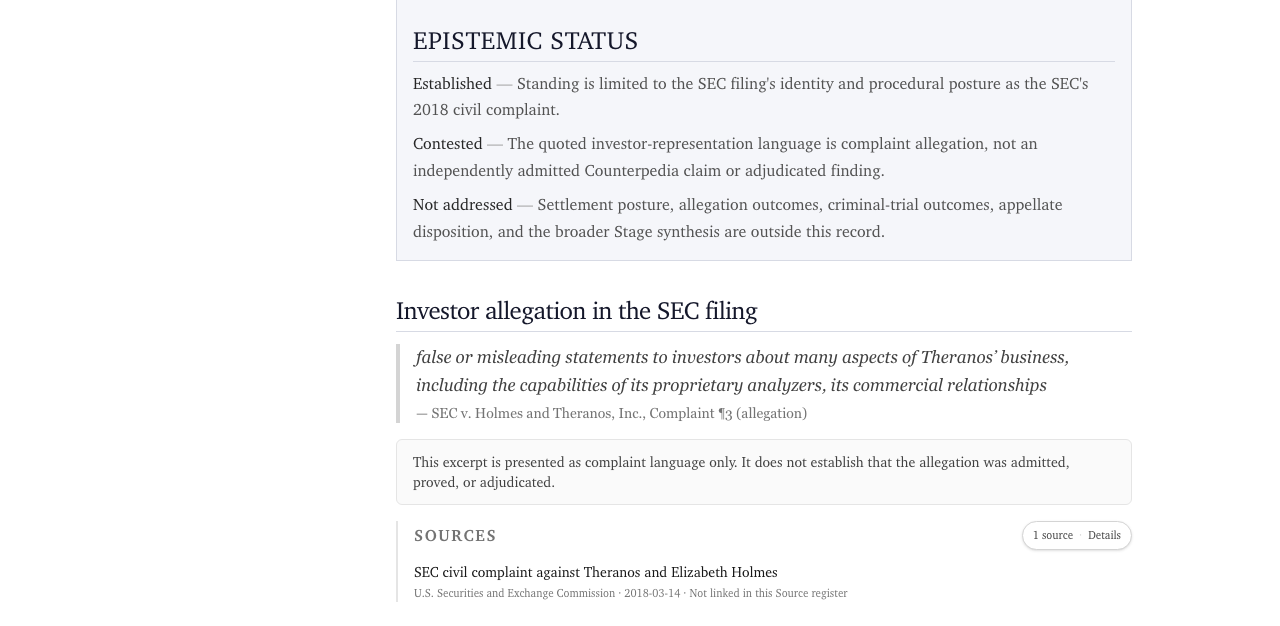
Use Theranos material to compare two attributed statements against the documents they cite. Preserve the speaker, document type, passage, and scope of each statement.
Starting material
Open the Theranos entry or case described in this chapter. Select one attributed statement and a second position relevant to the same question. Use their actual cited documents. You do not need to decide which participant is correct to complete this exercise.
1. Define the comparison question
Write the question narrowly enough that both documents can be compared against it. Identify the people, organization, activity, and time period included. Do not treat two documents mentioning Theranos as responses to the same question unless their contents support that comparison.
2. Identify each contribution
For each position, record the speaker or issuing body, the statement as presented, its date, and the document cited. Keep the document class explicit. An allegation, a reported measurement, and a finding have different roles; reproduce the role recorded for the selected document rather than assigning one from its title alone.
| Field | Position A | Position B |
|---|---|---|
| Speaker or issuer | Recorded attribution | Recorded attribution |
| Statement | Exact words or clearly labelled paraphrase | Exact words or clearly labelled paraphrase |
| Document and version | Supplied identifier and version | Supplied identifier and version |
| Document type | Recorded class | Recorded class |
| Passage location | Page, paragraph, block, or other supplied location | Page, paragraph, block, or other supplied location |
| Scope | Population, conduct, time, and question addressed | Population, conduct, time, and question addressed |
| Measurement basis | Method and conditions stated in the source, or not specified | Method and conditions stated in the source, or not specified |
3. Read the cited material in context
Open each passage and read the surrounding text needed to identify its scope. Record who makes the claim and whether the source is reporting another person’s position. Keep an explicit quotation separate from your interpretation. Preserve units, sampling conditions, or definitions that affect a reported result.
4. Describe the difference
State whether the positions concern the same proposition, different time periods, different populations, or different document roles. Record a disagreement only when the two statements address a comparable question. Record missing method information as missing rather than filling it from another document.
Keep two observations separate: the disagreement recorded between positions, and the extent of the evidence or assessment supplied for the question. Disagreement does not by itself establish uncertainty, and agreement does not establish support.
5. Retain the full comparison context
List all the sources supplied for the selected comparison. When describing a narrower subset, identify the sources left out and the reason for selecting it. Compare what the subset contains; do not describe a change in selection as a new Check result.
Output and completion check
Keep the comparison table and a short account of the differences. Every factual statement in that account should point to the position or document it describes. A reader should be able to separate the participants’ statements from your explanation and see which question remains unanswered.
Apply the procedure elsewhere
Repeat with a second pair of documents already associated with the same case, or with two versions of one attributed statement. Do not manufacture an opposing position to fill the table. A record with only one supplied position can still be described accurately.
Return to Cases and investigations, or continue with reading assessment scope.