Exploring sources and references
What this chapter does
Follow a reference until you can identify the document behind it, then tell the original publisher, an archived destination, a registered Source Record, and a held copy apart. You can complete this task without running Check.
Reader outcome
Starting from a subject reference or Source Atlas, identify one document’s issuer, title, version, permissible destinations, and whether retained material was actually shown.
The documents we’ll use
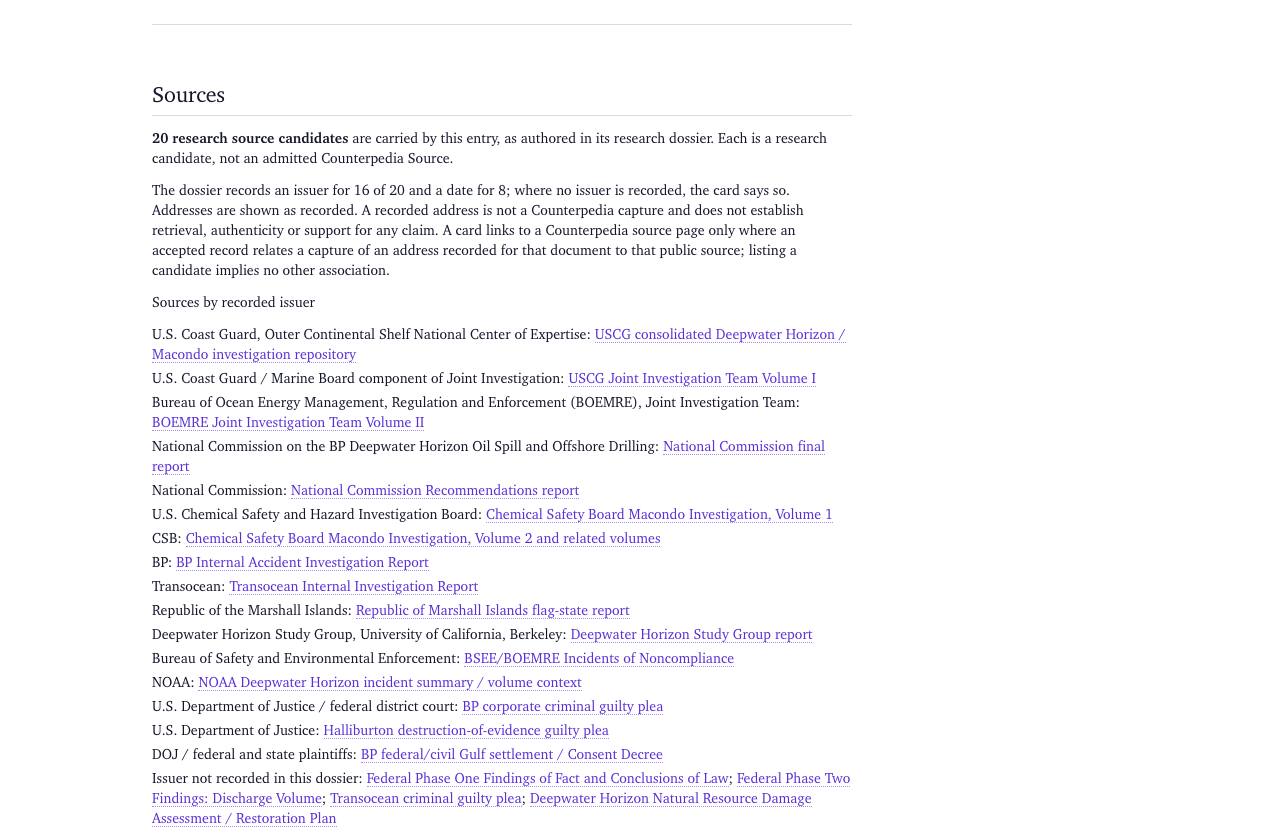
The 2010 Deepwater Horizon / Macondo accident produced several distinct investigation reports. Start with the Coast Guard’s official investigation repository as a source directory. Compare it with the National Commission’s January 2011 report and the Chemical Safety Board investigation. Those institutions brought different mandates to the same event; one organization’s hosting of another’s document does not make them the same author.
The separate Counterpedia research dossier contains candidate references, but its source inventory is a research aid, not proof that every listed PDF has been retained or assessed in the current release.
Before you begin
Have a cited title or document in mind and decide what you need from it: an accident sequence, a technical finding, a regulatory recommendation, or another bounded question. Public publisher pages can be read directly. A private item or licensed copy remains subject to its own access rules.
1. Enter through the cited reference
From an entry, subject, or research document, identify one reference. Read its displayed label, any publisher attribution, and the material it supposedly points to. If the reference leads to a source index rather than to a report, identify the actual child document before proceeding. A search match and an opened report are different outcomes.
Expected result: you can identify one report, not merely a page about the oil spill.
2. Check the publisher against the host
Read the report’s title page or the publisher’s description. The Coast Guard repository can host reports from a marine-casualty inquiry, a federal offshore regulator, and a company’s internal investigation. These may all be relevant without having the same evidentiary authority.
| Role | What to record | Why it matters |
|---|---|---|
| Repository or host | The site that supplies the link | It may not have written the report |
| Issuer or author | Organization on the report itself | Attributes the claims to their actual source |
| Investigation mandate | Marine safety, well control, process safety, or policy | Limits what the report set out to evaluate |
| Document identity | Title, volume, publication date, edition | Prevents mixing reports with similar titles |
A BP internal report remains BP’s report even when an official repository preserves it. Conversely, a Commission report is not a court’s allocation of legal fault.
3. Read the version you opened
From the National Commission record, note the title, publication date, and available file edition. Locate a passage relevant to your question. If you follow a Coast Guard-hosted PDF instead, record that report’s distinct title, volume, and issuer. Capture the precise page, section or stable text anchor when possible.
Do not replace a version with a later report solely because both discuss Macondo. Retain the dated version you actually used in your citation.
4. Start again from Source Atlas
Open Source Atlas and select a Source Record if the release contains one for your chosen report. Compare its registered title, issuer, edition, and recorded destinations to the publisher document you just read. Use the record’s actual identifier when displayed; do not derive an ID from a title or a URL.
If your chosen report has no registered Source Record, that is still a legitimate result. Continue from its external publisher document and record that the reference-only path did not supply a registered record.
5. Separate links from retained material
Inspect each available destination independently. A publisher original, archive copy, and Counterpedia-retained copy may have different dates, file contents, identifiers and access conditions. The presence of an archive link does not guarantee a held copy. A digest, where recorded, identifies particular bytes but does not authenticate every assertion in them.
| Observed state | Record it as | Do not call it |
|---|---|---|
| Document URL was cited | Reference available | Document captured or read |
| Publisher page or PDF opened | External document inspected | Counterpedia-retained bytes |
| Source Record located | Registered documentary identity | Independent substantive verification |
| Retained bytes opened | Specific copy inspected with its custody details | Proof of every assertion in that copy |
| Separate assessment opened | Specific Check questions and outcomes | A blanket ruling on the report |
6. Recover from gaps and access barriers
If a link breaks, search the issuing organization and exact report title or use a separately identified archive. If a document is restricted, do not infer that the content is false or missing everywhere. If the Source Record exists without a retained copy, keep both observations in your notes. If the only available report is another institution’s, describe its separate mandate rather than substitute it silently.
7. Keep a reproducible source trail
Return to the original subject or source record. Write down the document’s issuer, complete title, volume or version, publication date, URL or other permitted destination, the passage you read, and the distinction between external and retained material. Then explain what this source was competent to address, without making it stand for every conclusion about the accident.
Expected result: someone else can identify the same documentary work and determine what you actually inspected. Continue with Tracing information back to its source to connect a particular statement to one passage. Check remains a separate optional assessment.
Optional tutorials
The main procedure does not require these exercises. Choose a tutorial for a field-level comparison, or skip to the closing explanation below.
| Tutorial | Output |
|---|---|
| Separate a reference, document, and retained copy | Document/reference/retention comparison and a version-specific citation |
| Trace shared source origins | Documented origin chains, unresolved origins, and labelled source-set omissions |
Skip the optional exercise and read the closing explanation.
Tutorial: Separate a reference, document, and retained copy
Trace the Statue of Liberty source example through its reference and publisher document. Identify a retained copy only when the source view supplies one.
Starting material
Use the Statue of Liberty subject and one of the NPS references from the discovery chapters. Open the publisher document and the Library of Congress photograph record as separate documents. This exercise compares their recorded roles; it does not ask either document to establish everything said about the monument.
1. Start at the referencing statement
Record the subject identifier and the statement or paragraph that cites the NPS document. Record the reference provider and the exact destination. A reference supplied through a dataset and a document published by NPS have different origins even when the reader displays them together.
2. Identify the publisher document
Read the document’s title, publisher, and displayed date or edition. Record the URL you opened. Treat the URL as a locator: it tells you where to request the document, not which bytes every later visit will return.
If the document was opened directly from a publisher rather than through a subject reference, record that separate starting point. Do not add an on-site relationship to your notes that the product did not supply.
3. Inspect retention and version information
In the source view, distinguish these objects and states:
| Item | What to record |
|---|---|
| Reference | The statement or paragraph that contains it and the locator it carries |
| Source Record | Its supplied documentary identity and metadata |
| Publisher document | The publication and version you read at the publisher |
| Retained copy | The capture or artifact identifier, digest, and acquisition time supplied for that copy |
| Assessment | Its separate identity and the statement and material it evaluated |
Leave an unsupplied field explicitly unrecorded. A Source Record does not, by its name alone, establish retained bytes. An acquisition timestamp and a publisher’s document date are different fields. Do not use either as the date of the event described in the document without a stated basis.
4. Compare the photograph record
For the Library of Congress item, record the item title, contributor, date, collection, and item-specific rights statement. Compare its role with the NPS explanatory document. The item record describes a visual source; the other document provides an explanation. Record which question each source helps you inspect rather than counting them as two independent confirmations of one claim.
5. Produce the citation and inspection note
Cite the object and version you used. For a publisher page, retain its title, publisher, URL, and the relevant date information. For a retained artifact, also retain the supplied edition or capture identity. Record whether the underlying content was opened, only its metadata was inspected, or the reference could not be resolved.
Output and completion check
Produce one row for each document, with separate columns for the reference origin, publisher, inspected version, retention state, and any separate assessment. The exercise is complete when the reader of your notes can identify what you inspected without assuming that a link, a copy, and an assessment are the same object.
Apply the procedure elsewhere
Repeat the procedure on one Eotyrannus reference. An identifier such as a DOI identifies a reference target; it does not by itself prove that a local copy was retained. Use the actual source view to record the next step.
Return to Exploring sources and references, or continue with tracing shared origins.